Document Trust Layer

Stop trusting forged documents. Verify them.

Catch fake receipts, forged PDFs, and manipulated documents before your AI agents trust them. Built for APIs, MCP, and agent workflows.

Click_for_sound
Scroll_to_discover
STAGE 01 // SURFACE VIEW

What Vision Models See_

LLMs and OCR engines parse text at face value. If a receipt says $9,420.00, they believe it. Zero pixel inspection occurs.

STAGE 02 // TARGET ACQUISITION

Isolating The Anomaly_

DocVerify locks onto the mathematically suspicious total. The digits exhibit anti-aliasing patterns inconsistent with the surrounding font — a telltale sign of post-production editing.

STAGE 03 // DEEP ZOOM

Into The Pixel Grid_

As we zoom past the character boundary, the smooth typography dissolves into raw raster data. Each cell is a single pixel with an RGB color value captured from the receipt surface.

STAGE 04 // RASTER ANALYSIS

Reading The Raw Data_

R,G,B triplets reveal the true color of each pixel. Normal receipt pixels show uniform paper tones (230+). The highlighted anomaly region shows shifted warmth — evidence of re-rendered glyphs.

STAGE 05 // SENSOR FINGERPRINT

Cluster Mismatch_

Real photos carry a coherent noise fingerprint — every pixel matches the camera sensor that captured it. Our model groups pixels by their statistical signature. The anomaly region clusters separately, exposing itself as foreign content welded onto the original.

STAGE 06 // 3D ARCHITECTURE

Dimensional Proof_

Each pixel’s height now represents how far it sits from its local cluster. The anomaly region literally rises above the baseline — a 3D topographic map of manipulation that no human eye could detect.

STAGE 07 // VERDICT

Proof Of Manipulation_

Cluster outliers, font edge anti-alias mismatch, and DCT block boundary shifts converge — three independent forensic signals pointing to the same region. But edited photos are only one threat. Every AI image generation model leaves its own fingerprint.

STAGE 08 // PULLBACK

Threats Beyond Editing_

After we catch the edit, we step back. Generative AI is a different kind of attack — entire documents conjured from nothing. Two families. Two distinct fingerprints.

STAGE 09 // DIFFUSION

Refined From Noise_

Imagen 4 Ultra, Midjourney v7, and Stable Diffusion 3.5 start from pure noise and iteratively refine. The trajectory leaves frequency residue — peaks in the spectrum no real camera produces.

STAGE 10 // AUTOREGRESSIVE

Token By Token_

GPT Image 2 and Gemini Nano Banana 2 generate one token at a time, scanning left-to-right. Every token boundary is a tiny seam. Stitched together they form a predictable raster pattern.

STAGE 11 // BEYOND PIXELS

Document Forensics_

Even untouched photos may sit inside a doctored container. PDFs append every edit as a new layer — each one a forensic trail.

STAGE 12 // LAYER STACK

What A PDF Really Is_

Five revisions stack on top of the original: original document, font subset swap, content rewrite, annotation overlay, metadata rewrite. We read every layer.

STAGE 13 // REWRITTEN ROW

Two Thousand Becomes Thirty_

One transaction was re-stroked between revisions 2 and 3. The original glyph metrics still live inside the file — and the new metrics don’t match.

STAGE 14 // ASSEMBLED PROOF

Every Trace Examined_

Font subset hash, annotation rectangles, /ModDate vs /CreationDate gap, /Producer string. Each line confirms when and how the file was tampered.

STAGE 15 // FRAUD SIGNALS

Caught Before Trust_

Cluster mismatch. Anti-alias break. DCT shift. Diffusion FFT peak. Autoregressive seam. PDF revision delta. Every signal collected. Every agent informed before a fake gets believed.

RASTERIZING...
12×8 GRID
QuickMart
1247 Harbor Blvd • Suite 200 • CA 92618
TAX ID: 94-2847561 • TEL: (949) 555-0142
03/14/2026 14:32RECEIPT #8847
Server Rack Unit x2$4,200.00
Enterprise SSD 4TB$1,890.00
Cooling Module Pro$2,340.00
Network Switch 48P$990.00
Subtotal$9,420.00
Tax (8.25%)$777.15
Total$9,420.00
[VARIANCE DETECTED]Anti-alias Δ: 4.2σ above mean
PAYMENT: VISA ****4829 • AUTH: 7X92KM
RASTER DECOMPOSITION // TOTAL REGION
240,234224Δ8
232,236234Δ9
231,232232Δ6
224,227226Δ19
229,237222Δ14
237,240228Δ17
232,229221Δ17
243,239229Δ2
222,228236Δ13
228,230226Δ18
222,234216Δ6
237,243245Δ15
244,235229Δ4
238,245244Δ18
233,240229Δ5
227,229227Δ8
39,3642Δ12
246,247237Δ8
36,3757Δ9
243,240237Δ12
37,5251Δ4
240,244246Δ13
228,228221Δ19
230,235217Δ6
233,235237Δ6
236,228232Δ16
229,236223Δ17
227,239224Δ13
209,193176Δ207
218,202171Δ210
231,194172Δ222
220,196177Δ188
222,202163Δ227
231,184179Δ252
240,240239Δ19
230,242223Δ18
220,227213Δ10
238,230230Δ8
33,6954Δ10
230,240235Δ3
246,205162Δ217
235,183174Δ240
204,199184Δ235
227,212182Δ186
244,209162Δ212
240,183172Δ253
235,233229Δ7
226,226226Δ18
239,243230Δ19
227,233216Δ4
229,227234Δ14
238,233229Δ3
227,183187Δ202
204,216168Δ205
250,191170Δ226
216,193178Δ224
218,204177Δ218
233,203175Δ201
236,238234Δ2
226,227231Δ15
241,245235Δ7
234,240234Δ6
231,230233Δ16
241,238225Δ19
228,236219Δ6
235,231234Δ3
43,6245Δ11
232,242234Δ8
222,236229Δ14
69,3350Δ15
245,243231Δ13
242,243237Δ13
230,228223Δ4
221,225229Δ10
229,234231Δ12
228,236226Δ5
54,3558Δ6
244,240240Δ18
236,241224Δ13
234,240230Δ13
230,223219Δ17
235,233223Δ8
227,235234Δ17
224,225217Δ10
226,232226Δ6
236,240243Δ12
237,238231Δ2
231,241243Δ8
240,241239Δ17
233,237220Δ5
238,243243Δ18
239,231221Δ13
230,234223Δ15
228,232226Δ3
228,224229Δ14
224,230224Δ18

Document Rejected

Confidence: 99.8% • 3 independent signals

CLUSTER_OUTLIERFONT_VARIANCECOMPRESSION_SHIFT
Diffusion Signature: 99.2%
Autoregressive Pattern: matched
/Page 1Obj 4
/MediaBox[0 0 612 792]
/XObjectObj 142
/FontF1 142
Stream 187Obj 187
/ResourcesObj 11
/ContentsObj 142
/Annots[ 14 R ]
STREAM 142 :: REWRITE @ Δ +30,000
FIRST FEDERAL BANK
Statement Period: 03/01 – 03/31/2026
Acct ****6741STMT #04829
03/02Direct Deposit — Acme Corp Payroll+$5,420.00
03/04Whole Foods Market #2841-$87.34
03/06Apple — Subscriptions-$29.99
03/08Target Store — Cleveland OH-$143.21
03/12Wire Transfer — Domestic+$32,450.00
03/14PG&E Online Pmt-$184.62
03/16Shell Oil #4471-$58.40
03/18Amazon.com-$214.88
ENDING BALANCE$41,672.56
+$2,450.00
+$5,420.00
-$87.34
-$29.99
-$143.21
REWRITE+$32,450.00
-$184.62
-$58.40
-$214.88
Fraud Signals Captured_
CLUSTER_MISMATCHANTI_ALIAS_BREAKDCT_BLOCK_SHIFTDIFFUSION_FFT_PEAKAR_TOKEN_SEAMPDF_REVISION_DELTA
Surfaced via REST API • MCP • Skills before any agent reads the document
[SYS.FORENSIC_ENGINE]

Agents can read documents.
DocVerify helps them decide whether to trust them.

Why AI agents need
authenticity checks

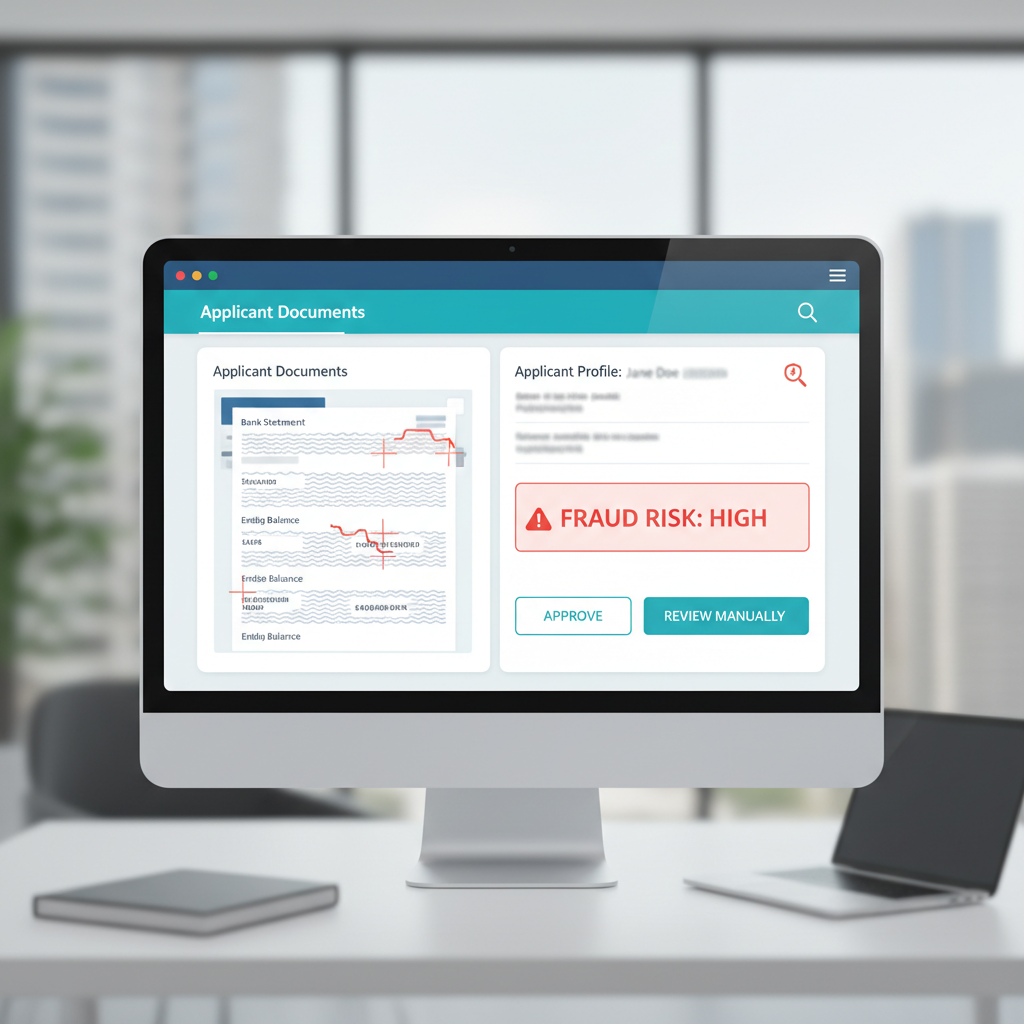
AI agents increasingly review uploaded receipts, onboarding documents, digital KYC verification files, proof of income, bank statements, invoices, claims files, and employment records. But document parsing is not document trust.

[01]

Clean OCR

A fake receipt can still produce clean OCR.

[02]

Official Look

A forged PDF can still look official.

[03]

Readable Data

A manipulated bank statement can still be readable by a model.

DocVerify gives agents a dedicated document authenticity check before they approve, reimburse, verify, or escalate. This helps reduce fraud risk in expense review, compliance workflows, onboarding, underwriting, and claims automation.

Core_Product

Document fraud detection
software for agents & APIs

DocVerify is purpose-built document fraud detection software for AI agents and developer APIs. Every uploaded receipt, bank statement, pay stub, invoice, ID, and PDF runs through forensic analysis — compression artifacts, font consistency, metadata traces, and transformer-based vision models — before your system trusts the contents.

// Documents we verify

  • Fake receipts
    Receipt verification
  • Pay stubs
    Pay stub fraud detection
  • Bank statements
    Bank statement verification
  • W-2 forms
    Fake W-2 detection
  • Invoices
    Invoice fraud detection
  • IDs & passports
    Fake ID detection
  • Utility bills
    Fake utility bill detection
  • Lease agreements
    Fake lease detection
  • Proof of income
    Proof of income verification
  • Proof of address
    Proof of address verification

Legacy OCR and template matching fail against modern AI-generated fakes. DocVerify's document fraud detection API surfaces pixel-level manipulation, edited regions, and GenAI artifacts in seconds — giving your agents and developer workflows a document authenticity signal they can trust. Integrate via REST API, MCP, or agent Skills.

Engine_Architecture

How DocVerify works

01Compression artifact analysis

DocVerify focuses primarily on image-based compression artifact analysis. Edited, patched, regenerated, or recompressed files often leave subtle traces in the image itself. DocVerify analyzes those patterns to identify hidden manipulation that may not be visible at normal zoom.

02Font & rendering consistency

Inserted text, regenerated content, or altered regions can behave differently from native content in the way characters render, align, and blend into surrounding document structure. DocVerify checks these consistency signals to identify suspicious regions.

03Metadata & edit traces

In parallel, DocVerify inspects metadata and editing traces to determine whether a file appears to have been modified by an editor, passed through a synthetic pipeline, or altered after original creation.

04Vision models for fraud detection

On top of forensic signals, DocVerify uses transformer-based vision models to detect image manipulation, document forgery, GenAI document detection signals, and suspicious edits in scans, screenshots, images, and rendered PDFs.

Result: Document authenticity assessment for agents, not just OCR.

Built for MCP, API, & Skills

DocVerify is built natively for AI agents and tool-calling models.

MCP

Let models natively call document verification inside agent workflows.

Document Verification API

Integrate document authenticity checks into apps, products, backends, fraud systems, and digital KYC verification flows.

Skills

Expose reusable document verification skills inside agent platforms and orchestration layers.

Use cases

Expense fraudFake receipt detectionForged PDF detectionDocument tamperingBank statement verificationProof of incomeEmployment lettersOnboarding reviewClaims screening
Product_02 // AI Agent Workflows

Build document verification agents in minutes

Describe your business validation logic in plain English. Deploy an autonomous verification agent as a REST API in seconds — forgery detection, policy checks, and structured results without standing up infrastructure.

01

Define your logic

Describe verification requirements in plain English.

02

Forgery detection

Neural forensics and Pixel Guard analysis detect tampering before your LLM sees the text.

03

Intelligence & tooling

The Intelligence Engine cross-references, calculates, and maps verified data.

04

Instant deployment

Provisioned as a REST API endpoint and A2A tool automatically.

SCALE_SECURELY

Pricing

Pick a monthly subscription that fits your volume. Need extra mid-cycle? Active subscribers can grab a top-up pack from their billing dashboard.

Dev

50 credits / month

$10.00

A low-friction monthly plan for individuals testing the waters.

  • $10/mo for 50 credits ($0.20 each)
  • Auto-replenishes monthly
  • Cancel anytime

Scale

500 credits / month

$100.00

Monthly capacity for consistent document review at the flat $0.20 / credit rate.

  • $100/mo for 500 credits ($0.20 each)
  • Auto-replenishes every billing cycle
  • Built for steady recurring demand
Best Value

Business

2,500 credits / month

$500.00

The cleanest option for teams that need reliable headroom without manual top-ups.

  • $500/mo for 2,500 credits ($0.20 each)
  • Prevents limits during high-volume runs
  • Priority processing for active teams

Ultra

50,000 credits / month

$10,000.00

Designed for enterprise-grade throughput, automation pipelines, and large review queues.

  • $10,000/mo for 50,000 credits ($0.20 each)
  • Enterprise-scale throughput
  • Best for platform-wide automation
Newsletter_

Stay in the loop

Product updates, document fraud research, and case studies — straight to your inbox. No spam.

Talk_to_us

Book a 15-min call

Pick a time that suits you — we’ll confirm shortly. No scheduling tool needed.

FAQ: AI Document Verification & Fraud Detection

What is AI document verification?

AI document verification is the process of using machine learning and computer vision to determine whether an uploaded document — such as a receipt, bank statement, pay stub, or ID — is authentic or has been tampered with. Unlike OCR, which only reads what a document says, AI document verification analyzes compression artifacts, metadata, font rendering, and pixel-level anomalies to detect forgery before any automated action is taken.

What is document fraud detection and how does DocVerify work?

Document fraud detection is the process of using AI and forensic analysis to identify whether a document — a receipt, pay stub, bank statement, ID, or invoice — has been forged, tampered with, or generated by AI. DocVerify runs uploaded documents through compression-artifact analysis, font and rendering consistency checks, metadata forensics, and transformer-based vision models to flag manipulation before your agent or backend trusts the contents. Unlike OCR, which only reads what a document says, document fraud detection answers whether it can be trusted.

Does DocVerify work as a document verification API?

Yes. DocVerify is available as a REST document verification API. Send a file via a POST request and receive a forensic authenticity score, tampered region heatmap, and metadata analysis in response. The document verification API is used in KYC onboarding flows, expense automation, lending underwriting, and AI agent pipelines.

Can DocVerify detect AI-generated or GenAI-modified documents?

Yes. DocVerify uses transformer-based vision models trained to detect synthetic generation patterns, pixel manipulation, and the subtle artifacts left by generative AI tools when they produce or modify document images.

Is DocVerify available as an MCP tool?

Yes. DocVerify is available as an MCP so models can call AI document verification natively inside agent workflows, without any manual integration steps.

What types of documents can be verified?

DocVerify supports JPEG, PNG, WebP, HEIC, TIFF, BMP, and GIF. Common use cases include receipt verification, bank statement fraud detection, pay stub authentication, ID document screening, invoice forgery detection, and proof-of-address validation. PDFs should be exported as images before submission.

Are Skills available for agent platforms?

Yes. DocVerify Skills are available for agent platforms that support reusable tool and workflow components, allowing teams to expose document verification as a callable skill inside their orchestration layer.

Latest_Research

From the blog

View all posts →

This site uses cookies for authentication and analytics. Free-tier uploads may be retained to improve our models; paid-tier uploads are never stored. Learn more