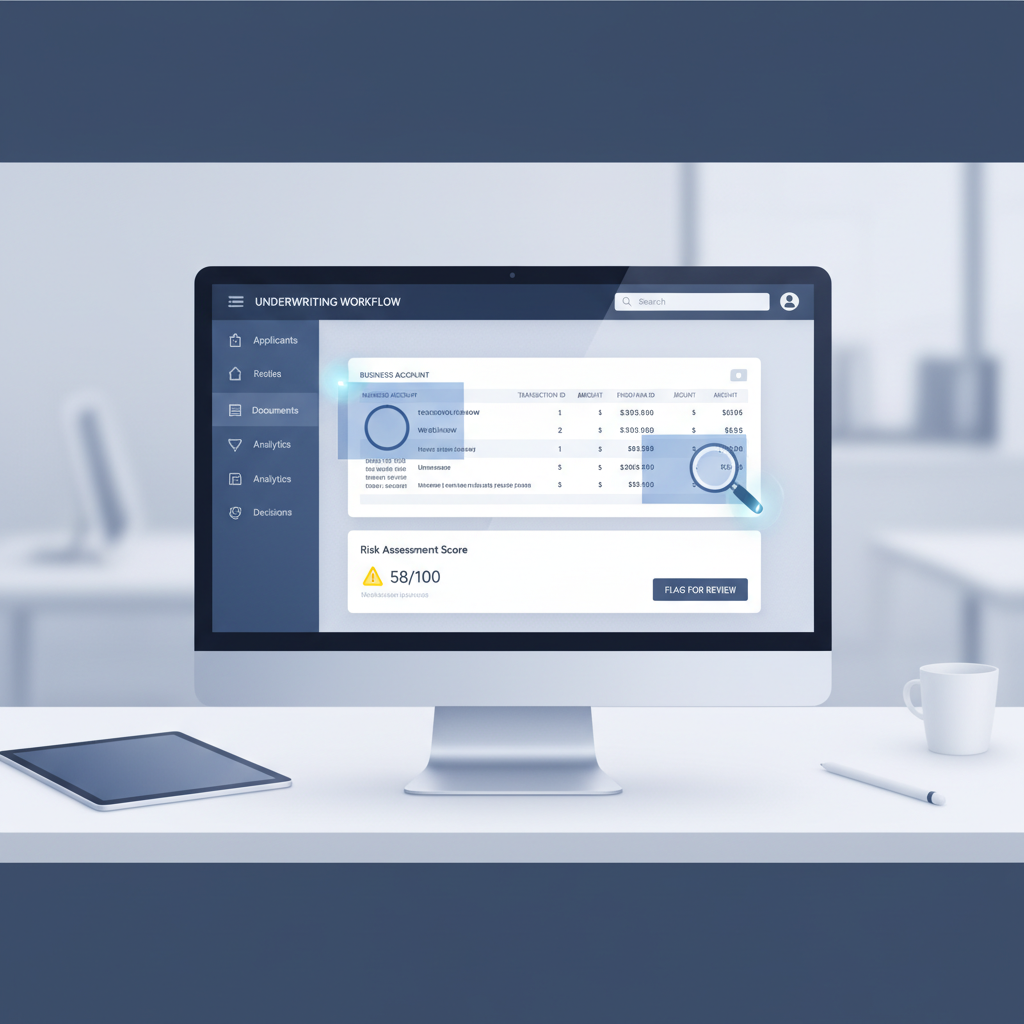
Small-business lenders and merchant cash advance teams already know that speed matters. The faster an underwriter can review cash flow, deposits, and recent account behavior, the faster a deal gets priced.
That is exactly why uploaded bank statements have become such a critical intake document, and exactly why they have become such a useful fraud surface.
The workflow gap: many SMB underwriting teams validate the numbers on the statement, but not whether the statement itself was manipulated before upload.
That gap is becoming more expensive. LexisNexis reported in 2024 that more than 80% of surveyed organizations saw SMB lending fraud rise year over year, with average fraud levels up nearly 14%. Industry operators are responding by shifting from labor-heavy review to tech-driven fraud prevention, especially earlier in origination.
Why This Problem Is Acute in Merchant Cash Advance and SMB Lending
In consumer lending, a forged bank statement is bad. In small-business underwriting, it can distort the entire picture of the company.
MCA and SMB funders often use submitted statements to answer questions like:
- How much revenue actually lands in the account each month?
- Is the business deposit pattern stable or deteriorating?
- Are there NSF events, overdrafts, or severe cash-flow swings?
- Does the activity support the requested advance size?
- Is the applicant presenting the real operating account at all?
If those answers come from a manipulated PDF or screenshot, the model, analyst, or approval rule downstream is starting from fiction.
What Fraudsters Actually Change on a Statement
The manipulation does not need to be dramatic. A fraudster usually changes the exact fields that affect underwriting confidence:
- ending balances to suggest stronger liquidity
- recent deposits to inflate recurring revenue
- returned-payment or overdraft activity to hide distress
- business name or account-holder details to make a statement appear tied to the applicant entity
- selected transaction descriptions to make cash flow look cleaner than it is
That is why statement fraud is not just a fake-document problem. It is an underwriting-input problem. Small edits in the right places can move a borderline file into the approve pile.
Why OCR and Manual Review Still Miss It
OCR is useful in this workflow, but only for extraction.
A forged statement with believable formatting and internally consistent numbers will often OCR perfectly. The system reads the balances, deposit amounts, and dates correctly. That does not make the source document real. It only means the fake was legible.
Manual review has a different weakness: the file often looks normal enough. Underwriters are working fast, many statements are mobile screenshots or portal downloads, and modern edits preserve layout well enough to survive a quick visual pass.
So the workflow often ends up with the worst combination:
- OCR produces clean structured data
- the analyst sees a plausible statement image
- the risk model and human reviewer both inherit the same false assumption that the document is genuine
We have written about the broader version of that trap in OCR Is Not Verification. In SMB underwriting, the same mistake shows up when the statement becomes trusted before authenticity is checked.
Where Bank Statement Verification Belongs
The most useful place for statement verification is right at intake, before the document becomes trusted underwriting evidence.
A practical workflow looks like this:
- Application intake collects uploaded bank statements, PDFs, or screenshots
- Document authenticity screening checks the uploaded statement before scoring or analyst use
- OCR or transaction extraction runs only after the file is cleared or risk-ranked
- Underwriter review uses both the extracted financial data and the authenticity signal
- Escalation path routes suspicious files to deeper review, digital verification, or direct bank-data alternatives
This is the same design principle strong AP teams are learning with edited invoices and supplier documents: do not let a downstream system treat the attachment as evidence before the attachment itself has been checked.
What DocVerify Can Claim Here, Based on the Current Product
Based on the current product and codebase, DocVerify is well matched to this intake step because it already analyzes the file types underwriters actually receive: PDFs plus common image formats.
Relevant signals for this workflow include:
- PDF structural flags and edit-localization output that can point to suspicious changed regions
- font provenance and glyph anomaly checks that help catch inserted or altered text in PDFs
- occluded or hidden PDF text analysis where overlays may conceal modifications
- metadata irregularities that do not match the claimed document origin
- compression and image-forensics signals that suggest re-saving or region-level editing
- model-based tamper localization to highlight suspicious statement areas for human review
That does not replace underwriting judgment. It makes the underwriting judgment less likely to start from a manipulated artifact.
A Better Rule for SMB Funders
If a bank statement is important enough to influence pricing, approval, or funding amount, it is important enough to verify before it is trusted.
That leads to a cleaner operating rule:
- clean statement + reasonable cash-flow profile → continue through normal underwriting
- suspicious statement → escalate before approval, request alternate evidence, or move to digital-bank verification
- uncertain document provenance → do not let the file become ground truth for the deal
The point is not to slow legitimate applications. It is to stop fraud from entering the workflow disguised as ordinary financial evidence.
Build the Trust Check Before the Credit Decision
Bank statement fraud in SMB lending is not just a back-office nuisance. It is a front-door underwriting problem.
If your team prices merchant cash advances, revenue-based financing, or small-business loans off uploaded statements, bank statement verification belongs at document intake, before OCR, before scoring, and before approval confidence compounds around a fake file.
- Try DocVerify: https://docverify.app
- Broader bank statement fraud context: Fake Bank Statements in Lending and Onboarding
- Why extraction is not enough: OCR Is Not Verification