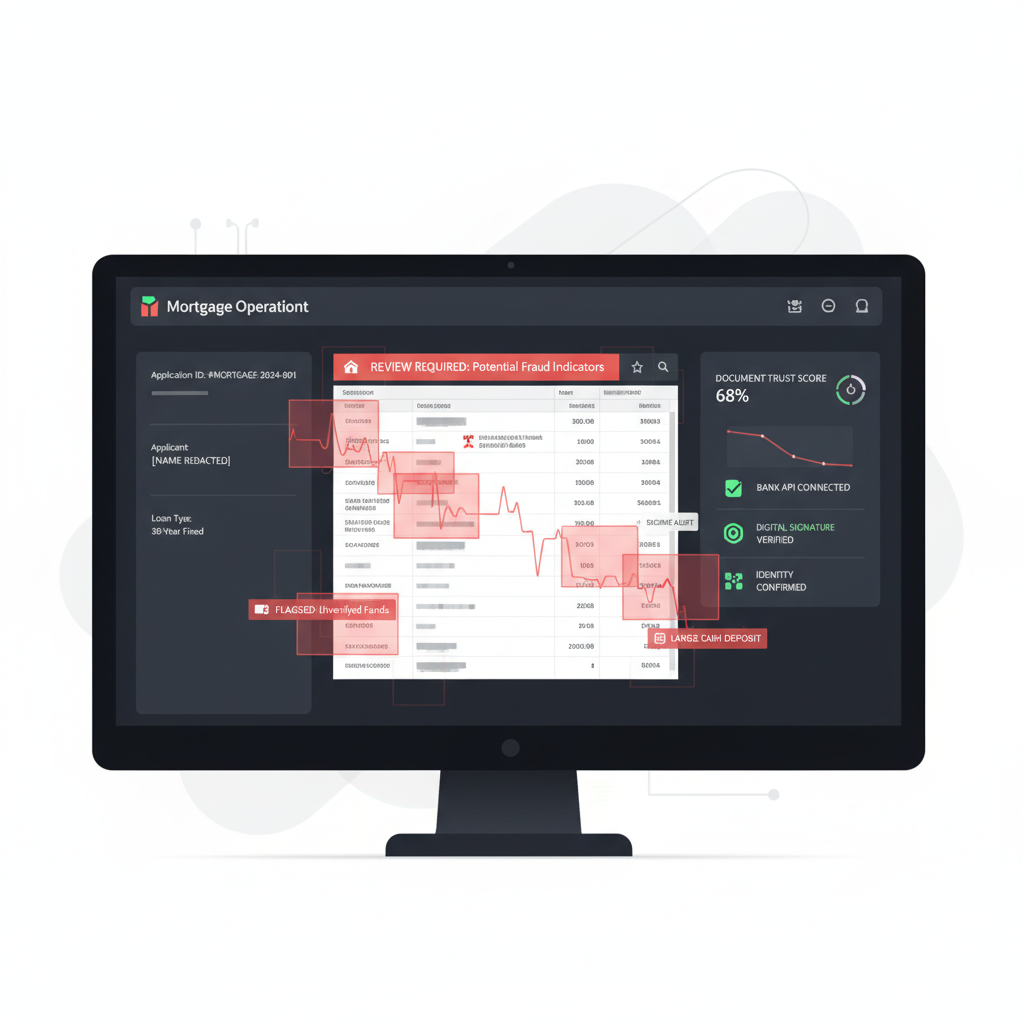
Mortgage underwriting has added more automation, more fraud controls, and more data sources over the last few years.
But one fragile trust assumption still survives in many pipelines: if a borrower uploads a bank statement that looks normal, the workflow often starts using it before anyone verifies whether the file itself was manipulated.
The missing step: many mortgage workflows validate the borrower and the numbers, but not the authenticity of the uploaded bank statement document.
That matters more in 2026 because fake financial documents are easier to produce, easier to lightly edit, and easier to move through fast-moving digital origination funnels.
Why Bank Statements Still Matter in Mortgage Files
Even with payroll connections, verification vendors, and broader data access, uploaded statements still show up constantly in mortgage underwriting.
They are used to support questions like:
- are there enough funds to close without relying on borrowed money?
- do recent balances support the declared asset picture?
- are there large deposits that need sourcing or explanation?
- does the account activity align with the rest of the file?
- are reserve requirements actually met?
If the uploaded statement is false, every downstream conversation about assets starts on the wrong foundation.
Why Existing Controls Miss This
Mortgage operations already have real controls. Loan officers collect conditions. Processors chase documents. Underwriters review balances, deposits, and liabilities. Fraud teams watch for occupancy, identity, and income issues. Automated systems help evaluate the file faster.
Those are valuable controls, but they usually answer questions like:
- does the file contain the required document?
- do the balances meet program requirements?
- does the data line up with other disclosed information?
- should this file move to the next stage?
They do not automatically answer the narrower question that matters first:
Was this bank statement altered before upload?
A forged statement can still produce clean OCR, plausible balances, and internally consistent transaction math. That is exactly why document authenticity needs its own control layer.
What Fraudsters Actually Change
Mortgage statement fraud is often less dramatic than people expect. The file does not need to look fake. It only needs to remove one underwriting objection.
That can mean:
- raising the ending balance to clear funds-to-close requirements
- editing away overdrafts or NSF events
- changing transaction descriptions around large deposits
- swapping borrower-identifying details onto a stronger account history
- submitting a screenshot or exported PDF that conceals earlier edits
In each case, the underwriting discussion shifts because the document changed, not because the borrower profile really improved.
Where Bank Statement Verification Belongs in the Workflow
The most useful place is near document intake, before the statement becomes trusted underwriting evidence.
- Borrower uploads bank statement through portal, email, or POS flow
- Document verification runs on the file itself before balances are trusted
- Clean files continue to OCR, asset review, and underwriting analysis
- Suspicious files route to exception review before conditions are cleared
- Only then should the statement inform approval confidence, reserves, or funds-to-close conclusions
This is the same sequencing logic that matters across lending more broadly: verify the evidence file first, then let extraction and decisioning build on top of it.
Why OCR and Manual Review Are Not Enough
OCR is useful because it extracts what the statement says. Underwriters are useful because they understand context, exceptions, and policy. Neither one is a document-forensics layer by default.
If a PDF has been edited cleanly, OCR may read the altered values perfectly. If a screenshot was re-exported after manipulation, a human reviewer may see a familiar layout and a plausible balance history. If the file looks calm, the process usually calms down around it.
That is the core risk. The workflow starts treating the uploaded statement as evidence before the file has earned that status.
What DocVerify Can Credibly Check Here
Based on the current product and codebase, DocVerify fits this intake step because it already analyzes PDFs and common image uploads, the same formats mortgage teams routinely receive in portal-based origination.
Relevant signals for mortgage statement review include:
- PDF structural anomalies that do not match a normal statement origin
- metadata irregularities that suggest editing or re-export chains
- font provenance and glyph anomalies around altered text regions
- occluded or hidden text analysis where overlays may conceal changes
- recompression artifacts in screenshots and image-based submissions
- model-based tamper localization that points reviewers toward suspicious areas
That does not replace underwriting judgment, direct-source verification, or fraud operations. It closes the earlier gap where an uploaded file becomes trusted simply because it is present and readable.
A Better Rule for Mortgage Teams
If a bank statement is important enough to support funds-to-close, reserves, or asset stability, it is important enough to verify before it shapes the file.
- clean document + consistent borrower data + normal underwriting review → continue
- suspicious document → escalate before clearing conditions
- uncertain file provenance → do not let extraction accuracy substitute for trust
That is the practical shift. Do not ask only whether the statement supports the loan. Ask whether the statement itself deserves to be used as evidence.
Mortgage Automation Needs a Trust Layer Too
Lenders are moving faster, which makes document trust more important, not less. A cleaner portal, faster OCR, or smoother workflow does not make an uploaded statement authentic.
If your mortgage workflow still accepts borrower-uploaded statements, bank statement verification belongs before underwriting confidence compounds around them.
- Try DocVerify: https://docverify.app
- Broader bank statement fraud angle: Fake Bank Statements Are Everywhere
- Workflow example in SMB lending: Merchant Cash Advance Fraud